

LPG: domestic and industrial uses of a versatile fuel
From the kitchen to industrial processes, an overview of the many uses of liquefied petroleum gas.
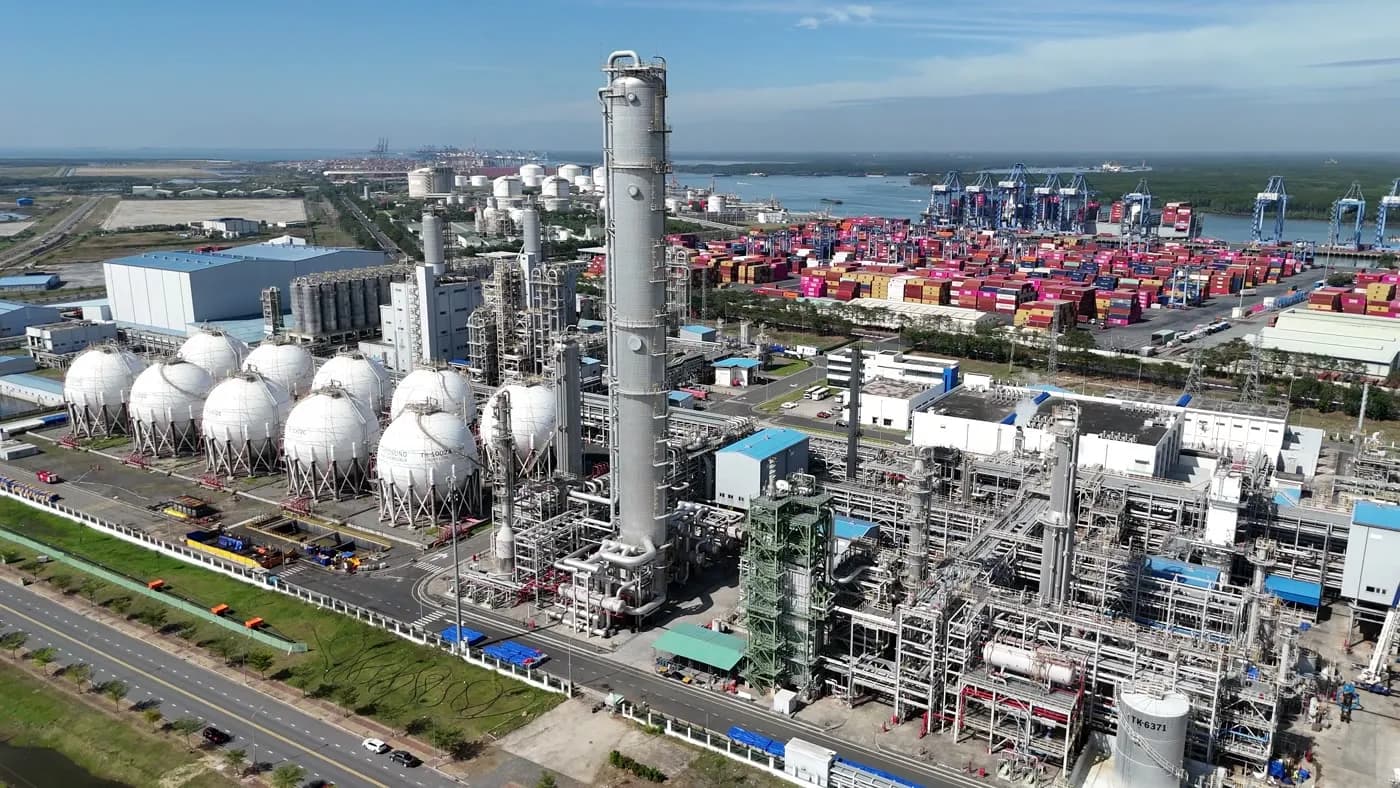
Liquefied petroleum gas (LPG) is a mixture of light hydrocarbons, mainly propane and butane, recovered from natural gas processing and crude oil refining. Its defining feature is a simple physical property: at ambient temperature, moderate pressure is enough to keep it liquid, in a volume roughly 250 times smaller than as a gas. That is where all of its versatility comes from.
LPG does not need a grid: it goes wherever the energy has to go, in a cylinder, a tank or an ISO container.
A liquefied gas, a flexible supply chain
Because it travels as a liquid, LPG uses every logistics mode: pressurised or refrigerated vessels, ISO tank containers, road tankers, bulk tanks at the customer's site and, at the end of the chain, cylinders of a few kilogrammes. It can serve an industrial zone connected to a terminal just as easily as a household far from any distribution network.
The composition of the mixture is not neutral. Propane boils at around −42 °C and butane at around 0 °C: a propane-rich mixture stays usable in cold weather, while a butane-rich one suits hot climates and carries slightly more energy per litre. The ratio is therefore chosen according to climate and application, and forms an integral part of the commercial specification.
Added to that flexibility is a high energy density: one kilogramme of LPG releases around 46 megajoules, more than natural gas for the same mass. A 12.5 kg cylinder therefore covers several weeks of cooking for a household, with no fixed installation and no connection to a network.
Domestic uses
This is the most visible use. Cooking, domestic hot water and space heating account for most residential LPG consumption worldwide. Its advantages: immediate, controllable heat, high efficiency, and combustion without soot or particulates. This is a decisive health benefit wherever cooking still relies on wood or charcoal, with the well-documented consequences for indoor air quality.
For isolated homes, poorly served peri-urban areas or seasonal residences, LPG acts as a portable gas network: the tank or the cylinder replaces the pipeline, with no infrastructure works.
Industrial and agricultural uses
In industry, LPG is above all a process fuel, valued for the cleanliness of its flame and the precision of its control:
- Process heat in kilns and ovens: ceramics, glass, construction materials, metal heat treatment.
- Food processing: baking, roasting, drying, sterilisation, wherever contact between flame and product demands clean combustion.
- Metalwork: cutting, brazing, weld preheating.
- Materials handling: LPG-powered forklifts, usable indoors thanks to markedly lower exhaust emissions than diesel.
- Automotive fuel (autogas), governed by a dedicated standard in several markets.
- Petrochemical feedstock: propane feeds steam crackers and dehydrogenation units to produce the ethylene and propylene behind most plastics.
Agriculture uses it seasonally but intensively: crop drying, greenhouse and livestock building heating, flame weeding.
A seasonal, global market
LPG is traded globally, with two features that set it apart from liquid fuels. First, seasonality: residential demand peaks during the northern hemisphere winter, which feeds through to prices and to vessel availability. Second, the plurality of price references: cargoes are indexed according to their origin or destination area, each regional market having its own quotations for propane and butane.
Volumes follow the same logic of flexibility as the rest of the chain: from an ISO tank container of a few dozen tonnes for an industrial user, up to the very large gas carriers that supply import terminals. In between, regional short-sea shipping and road transport provide fine-grained delivery to depots and cylinder filling plants.
Quality, specification and safety
Like any petroleum product, LPG answers to public specifications: composition and vapour pressure, evaporation residue, copper strip corrosion, sulphur content, absence of free water. The most widely cited references are the American standard ASTM D1835 for commercial LPG and the European standard EN 589 for automotive fuel.
Since pure LPG is odourless, a sulphur-based odorant is added so that any leak is detectable well below a hazardous concentration. Three rules complete that safeguard and are worth restating at every installation:
- Ventilate at floor level. Heavier than air, LPG accumulates in low points; cellars and pits are unsuitable for storage.
- Respect the filling ratio. Cylinders and tanks are never filled to 100 %: an ullage volume lets the liquid expand without overpressure.
- Check the accessories. Regulators, hoses and fittings have a limited service life, and cylinders are subject to periodic requalification.
Environmentally, LPG contains virtually no sulphur and burns without particulates or smoke, which makes it a useful transition option against coal, wood or heavy fuel oil for thermal applications. Renewable LPG, produced from wastes and residues, is also starting to develop, using the same equipment and the same distribution networks.
Talk to us
Do you need an LPG supply, in cylinders, in tanks or in bulk? Contact our team or read our LPG product page.
News & Insights.